The Book

Now available: ebook and paperback, in Spanish and Italian. An English edition is in preparation.
A book that develops the theoretical foundations and documents the clinical practice of this proposal. Based on more than thirty years of experience and on the integration of the psychomotor work of Aucouturier and Pikler, the phenomenology of the body of Fuchs, and the theory of enaction of Varela and Maturana.
Available for pre-order now — launching October 3, 2026, in Spanish and Italian. This page describes the book in English for international visitors; there is currently no English edition
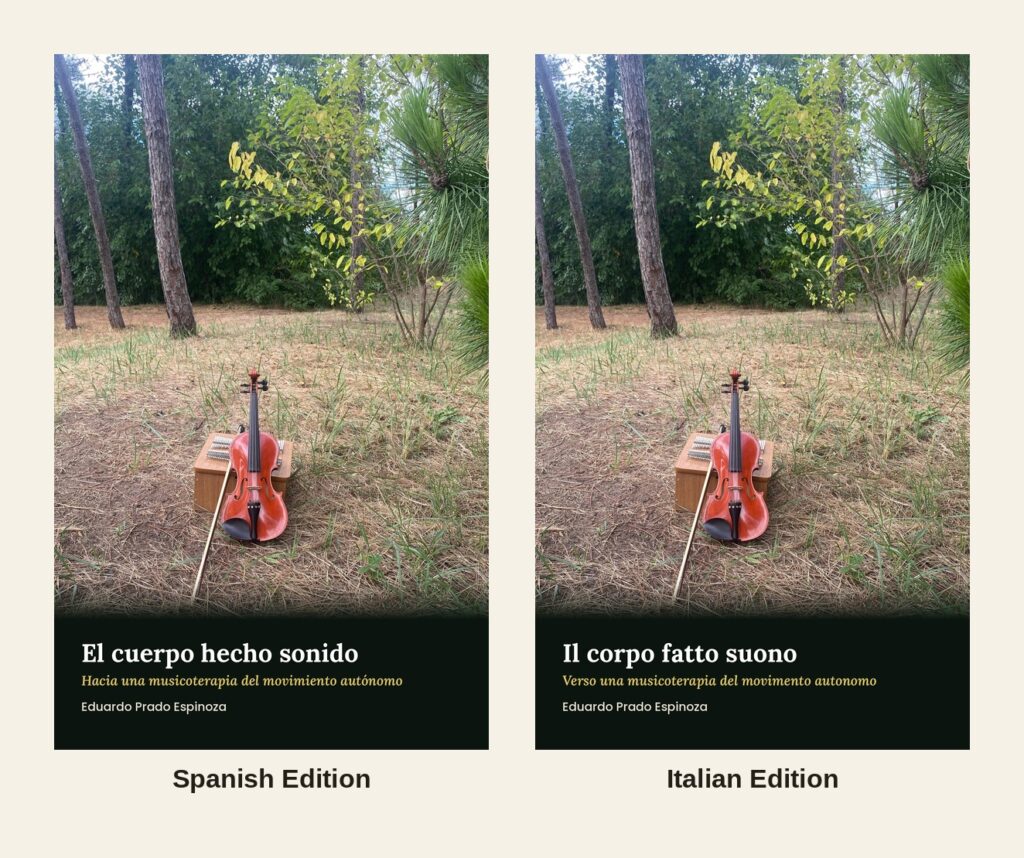
In South America the Spanish paperback is printed in the region: price in local currency, plus home delivery. The Spanish ebook (Kindle) is available on Amazon.
INTRODUCTION
What happens when a person enters a room, closes the door, and decides for themselves what to do with what is available?
This seemingly simple question opens a new way of understanding music therapy. It is not the field’s usual question, which tends to ask how the therapist can facilitate a meaningful encounter with the patient, how to co-create meaning through music, how to sustain a therapeutic relationship that produces change. These are legitimate questions, and they have produced rigorous, valuable models. But all of them assume the gesture has already happened — that the subject is already in motion, already in relationship.
This book asks something prior: how is it possible for that gesture to happen at all. What conditions does the subject need in order to initiate it from within, without anyone having asked for it. And what role music plays — not as stimulus or provocation, but as a temporal structure that sustains without determining, that precedes without prescribing, that continues while the subject finds their own way.
The answer comes from three fields that music therapy had not, until now, integrated systematically. From the psychomotor work of Bernard Aucouturier, who showed that spontaneous play in a prepared space is therapeutic prior to any adult intervention. From the psychosemiotics of Peirce and Eco, which offers tools for reading that play as a narrative with its own structure — a narrative program the therapist learns to read without interrupting. And from Francisco Varela’s theory of enaction, built on the foundations of Humberto Maturana’s autopoiesis, which explains why the autonomous gesture is not an absence of method, but the most primary and genuine way a living being constructs experience in the world.
What this book proposes is that music therapy can operate at that level — the level of the gesture no one asked for, of the subject who enters their own room and closes the door — and that doing so does not mean abandoning rigor, but carrying it into territory still to be explored.
The book documents this proposal with real clinical cases in Italy: a preschool, a nursing home, a center for people with deafblindness, and a context of maximum neurological complexity.